
Search

Sign In Join Free

1 / 1
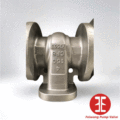
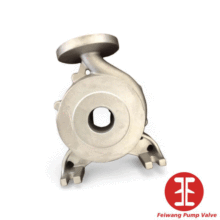
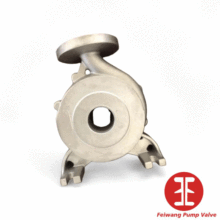
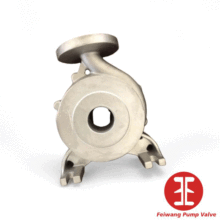
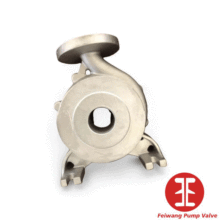
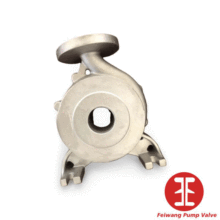
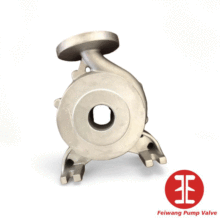
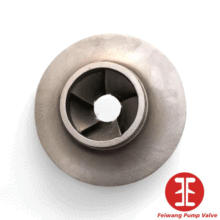
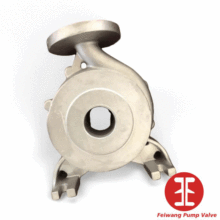
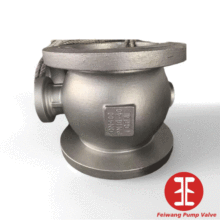
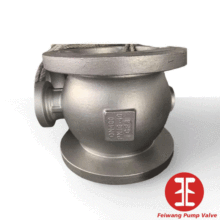
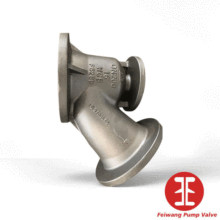
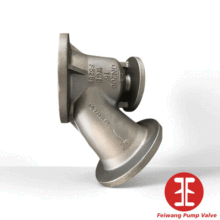
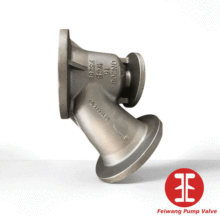
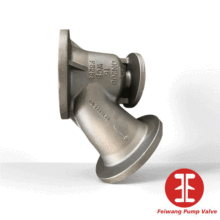
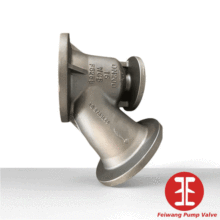
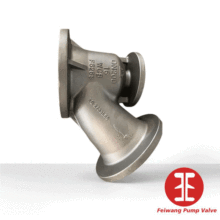
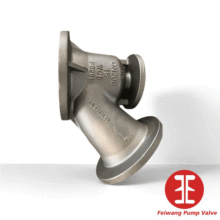
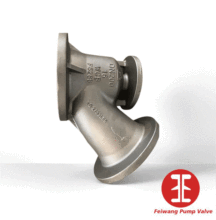
Industrial Grade Stainless Steel Pump Castings
Get Latest Price
You might also like
Basic Info
| Model No. | FW018 |
|---|
Product description
In the field of mechanical manufacturing and equipment maintenance, 1Cr13 martensitic stainless steel (equivalent to 410) has become the core material choice for many scenarios due to its strong adaptability. Its applicable temperature range of -20℃ to 450℃ perfectly fits the working environment of general mechanical structures, cutting tools, valve internals and other components, eliminating the need to worry about performance failure caused by temperature fluctuations.
In valve manufacturing, the internal components made of 1Cr13 can withstand the erosion of the medium and slight corrosion, and are less likely to experience sealing failure after long-term use, ensuring the stable operation of the pipeline system. When used as a cutting tool material, its high hardness after heat treatment can meet the cutting requirements of various metals and non-metals, and its service life is more than 30% longer than that of ordinary carbon steel cutting tools. When used in components such as bearings and springs, it features a good balance of strength and toughness, capable of withstanding long-term mechanical stress and reducing the frequency of component replacement.
In addition, the advantages of 1Cr13 are also reflected in processing and cost. Good mechanical processing performance can reduce the production cycle and processing cost, and high-precision forming can be achieved without special equipment. Compared with stainless steel containing precious metals such as nickel and molybdenum, the composition system with only 13% chromium has a greater cost advantage. In scenarios that meet the basic requirements of strength and corrosion resistance, it can reduce equipment manufacturing costs for enterprises with high cost performance and is a highly adaptable material for high-strength and corrosion-resistant demand scenarios in the industrial field.


?


Industrial Grade Stainless Steel Pump Castings
Get Latest Price
Send your inquiry to this supplier
You may also be interested in
- Stainless Steel Castings
- for steel castings
- stainless steel industry
- various stainless steel castings
- pump castings
- stainless castings
- Stainless Steel Precision Castings
- steel castings
- stainless steel pump
- Pump Stainless Steel
- for steel industry
- stainless steel industry pipes
- stainless steel industry baske
- industry pump
- pump parts castings
Product Categories
New products
Send Inquiry
Product Alert
Subscribe to your interested keywords. We will send freely the latest and hottest products to your Inbox. Don't miss any trade information.
Subscribe
Your use of this website constitutes acknowledgement and acceptance of our Terms & Conditions.
Copyright ? 2009-2026 Bossgoo Co., Ltd. All rights reserved.
版權(quán)所有 ? 寧波全貿(mào)信息技術(shù)有限公司 浙ICP備12012821號(hào)-1 浙B2-20200628
