
Search

Sign In Join Free


1 / 1
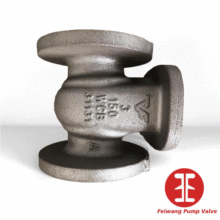
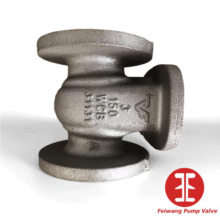
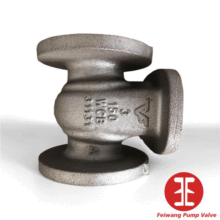
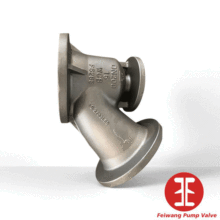
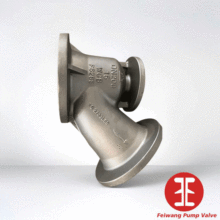
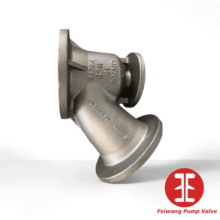
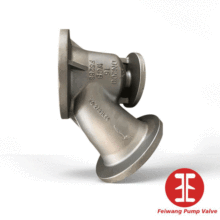
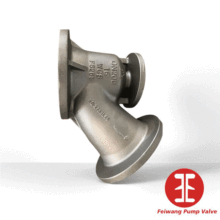
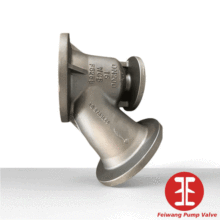
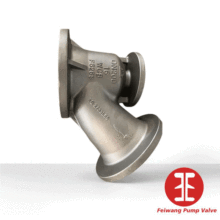
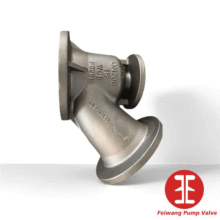
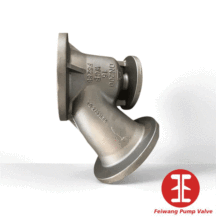
Low Temperature Carbon Steel Valve Castings
Get Latest Price
You might also like




Basic Info
| Model No. | FW031 |
|---|
Product description
LCC (ASTM A352 Grade LCC), as a low-temperature high-strength carbon steel casting, its core competitiveness stems from precise composition design and performance optimization, and is specially crafted for the harsh temperature range from -46 ° C to +345 ° C. In terms of composition, the carbon content is strictly controlled at ≤0.20%, which not only ensures the basic mechanical properties (tensile strength ≥550MPa, yield strength ≥345MPa), but also avoids the brittleness defect of high-carbon materials at low temperatures. Nickel and manganese elements work in synergy. Nickel can refine the grain structure and lower the ductile-brittle transition temperature, enabling the material to maintain excellent toughness even in an extremely cold environment of -46 ℃. The low-temperature impact absorption energy reaches over 27J, far exceeding the 10J standard of ordinary carbon steel, effectively eliminating the risk of fracture under low-temperature conditions.
This component advantage also extends to multiple properties: Good weldability makes the splicing of complex structural components more reliable, and the low-temperature toughness of the welded joint deviates from the base material by less than 5%. Excellent processability supports high-precision manufacturing. For instance, the surface finish of the valve sealing surface can be stably controlled within Ra0.8μm. The basic corrosion resistance can withstand the corrosion of trace amounts of hydrogen sulfide in natural gas and light hydrocarbons in low-temperature petrochemical media. Even when frequently opened and closed under low-temperature and high-pressure conditions, LCC can still maintain structural stability and sealing performance, with a service life that is over 30% longer than that of ordinary low-temperature carbon steel, providing a solid material guarantee for low-temperature fluid control.


?


Low Temperature Carbon Steel Valve Castings
Get Latest Price
Send your inquiry to this supplier
You may also be interested in
- Carbon Steel Sand Castings
- Carbon Steel Investment Castings
- Carbon Steel Shell Castings
- valve castings
- carbon steel valve
- steel castings
- Valve Investment Castings
- valve body castings
- Valve Bodys Castings
- carbon steel regulating valve
- carbon steel gate valve
- carbon steel ball valve
- carbon steel check valve
- carbon steel globe valve
- Carbon Valve
Product Categories
New products
Send Inquiry
Product Alert
Subscribe to your interested keywords. We will send freely the latest and hottest products to your Inbox. Don't miss any trade information.
Subscribe
Your use of this website constitutes acknowledgement and acceptance of our Terms & Conditions.
Copyright ? 2009-2026 Bossgoo Co., Ltd. All rights reserved.
版權(quán)所有 ? 寧波全貿(mào)信息技術(shù)有限公司 浙ICP備12012821號(hào)-1 浙B2-20200628
