
Search

Sign In Join Free




1 / 3
Portable Infrasound Detector with Bluetooth | Real-Time Waveform Display on Mobile App
$385.00
~ $435.00
/ Set/Sets
Get Latest Price
You might also like

$385.00
1 Set/Sets (MOQ)

Basic Info
| Brand Name | Brace |
|---|
Product description
Introduction to the Portable Infrasound Waveform Detector
Overview
A Portable Infrasound Waveform Detector is an electronic instrument designed to capture, process,
and visualize low-frequency acoustic waves. Its primary function is to convert infrasound waves—acoustic
vibrations with frequencies below the human hearing threshold of 20 Hz—into visible waveform graphs,
enabling observation and analysis.
?
How It Works
? 1.The device operates through three main stages:Signal Acquisition: A high-sensitivity sensor inside
the detector picks up minute pressure changes in the ambient environment caused by infrasound.
? 2.Signal Processing: The acquired analog signal is conditioned through amplification and filtering
(featuring out-of-band attenuation >60 dB/octave) to improve the signal-to-noise ratio.
An Analog-to-Digital Converter (ADC) then transforms the analog signal into a digital data stream.
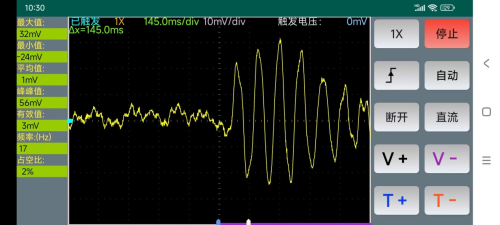
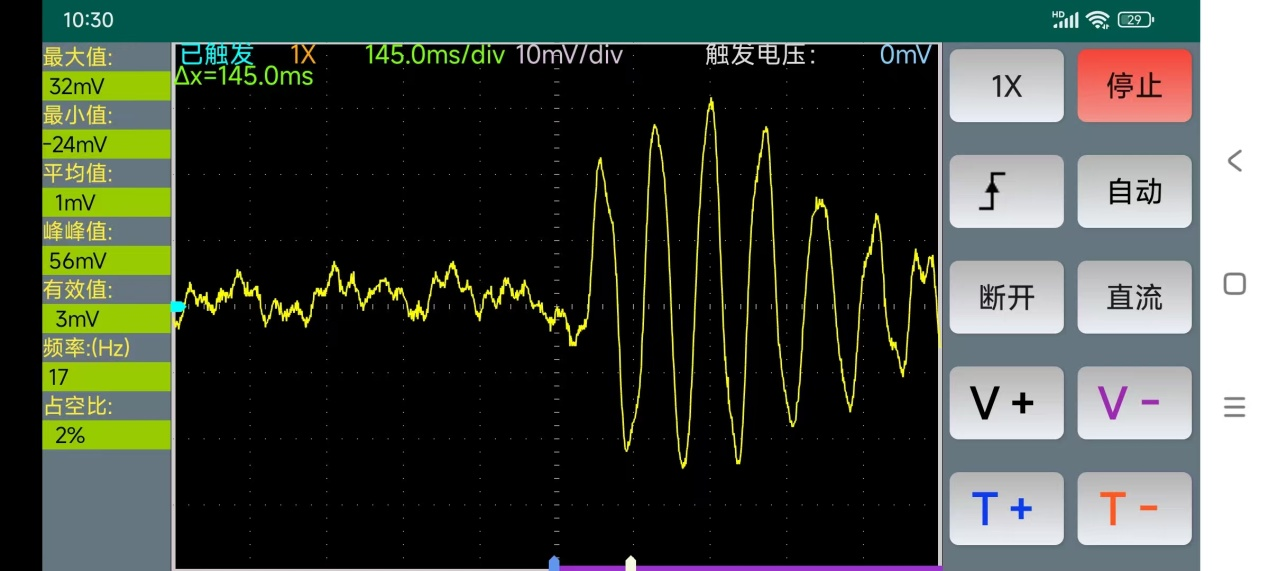
? 3.Data Transmission & Visualization: The processed digital data is wirelessly transmitted via low-energy
Bluetooth to a smartphone or tablet. A dedicated application allows the user to view the infrasound waveform in
real-time. This app typically provides adjustable timebase (0.25μs—50s) and vertical sensitivity(5mV/Div—5V/Div)
settings. The display can also be mirrored to a larger screen, such as a television, for group observation.
Key Technical Specifications
? ·? Frequency Response: The effective detection range is 1 to 20 Hertz (Hz), covering the primary infrasound spectrum.
? ·? Measurement Range & Sensitivity: It offers two effective ranges. At the 0 to 5 Pascal (Pa) range, sensitivity is
approximately 0.5 Volts/Pascal (V/Pa). At the 0 to 10 Pascal (Pa) range, sensitivity is approximately 0.25 V/Pa.
? ·? Portability & Battery Life: The device is compact (approximately 100 x 60 x 25 mm), charges via a Micro USB port,
and provides approximately 8 hours of continuous operation on a full charge, making it suitable for extended field use.
? ·? Status Indicators: LED indicators display power status, low battery voltage, and charging status.
Typical Applications
Due to its portability and visualization capabilities, this detector is suited for various scenarios:
? ·? Geoscience Education: Demonstrating infrasound phenomena in teaching settings, such as simulating seismic waves or vibrations from large machinery.
? ·? Environmental Monitoring: Monitoring potential infrasound sources in specific areas, like low-frequency signals generated by storms or topographic changes.
? ·? Preliminary Industrial Analysis: Conducting initial on-site waveform observation of low-frequency vibrations from equipment like large fans or boilers.
? ·? Hobbyist Research: Providing enthusiasts in physics and electronics with a tool to explore the inaudible world of sound waves.
Conclusion
By integrating sensor technology, wireless communication, and mobile applications, the Portable Infrasound Waveform Detector
lowers the barrier to observing and studying infrasound, offering a convenient solution for education, scientific research, and field monitoring.



Portable Infrasound Detector with Bluetooth | Real-Time Waveform Display on Mobile App
$385.00
~ $435.00
/ Set/Sets
Get Latest Price
Send your inquiry to this supplier
You may also be interested in
- Portable Mineral Detector
- Portable Gas Detector
- Gas Detector Portable
- portable trace detector
- portable lie detector
- portable explosive detector
- portable CO detector
- Portable Metal Detector
- portable needle detector
- portable oxygen detector
- Portable Gas Leakage Detector
- digital portable gas detector
- radar detector detector
- Money Detector Cash Detector
- Counterfeit Detector Money Detector
Product Categories
New products


$385.00
1 Set/Sets (MOQ)


Send Inquiry
Product Alert
Subscribe to your interested keywords. We will send freely the latest and hottest products to your Inbox. Don't miss any trade information.
Subscribe
Your use of this website constitutes acknowledgement and acceptance of our Terms & Conditions.
Copyright ? 2009-2026 Bossgoo Co., Ltd. All rights reserved.
版權(quán)所有 ? 寧波全貿(mào)信息技術(shù)有限公司 浙ICP備12012821號-1 浙B2-20200628
